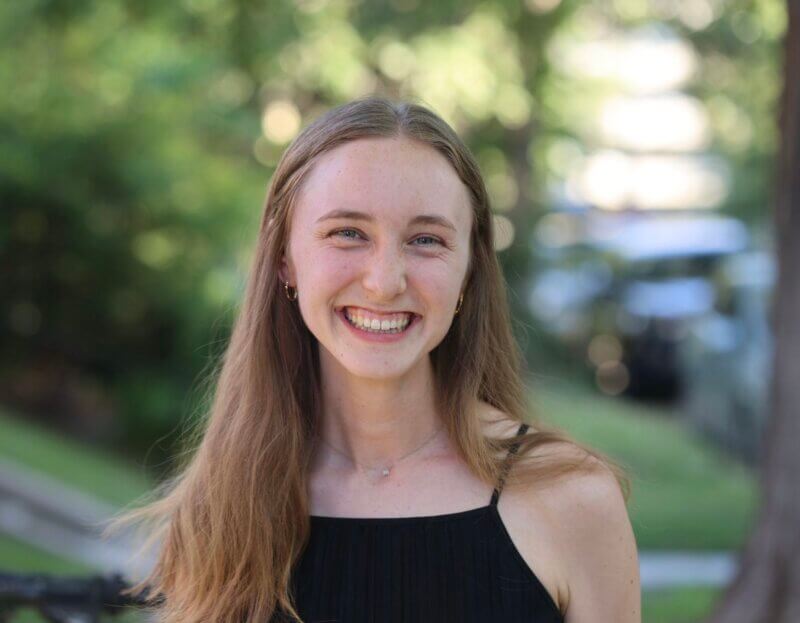
If you’ve volunteered at Project Worthmore, chances are you’ve met Maria. As our Volunteer Manager, she is often one of the first people to welcome someone through our doors, whether they’re here for their first volunteer shift or have been part of our community for years. She knows our volunteers, remembers their stories, finds ways for them to contribute, and helps create the connections that make people want to keep coming back.
Maria spends her days connecting people to one another. And in many ways, that is exactly what she has helped make possible at Project Worthmore. She is a big part of what makes our volunteer community feel like a community in the first place.
After college, Maria knew she wanted to do something really meaningful, but she wasn’t sure exactly what that would look like. She decided to spend a year in volunteer service, moving to Denver and living with a group of people from across the country and around the world. Each person was placed with a different nonprofit, and for Maria, that experience became the beginning of a career built around community and connection.
“I ended up doing a year of volunteer service, so I worked for free in Denver,” Maria said. “That’s kind of how I ended up in the nonprofit world, was being a volunteer myself.”
That experience would eventually lead her to Project Worthmore.
During her time at SAME Café, a nonprofit restaurant in Denver that Project Worthmore now partners with, Maria became involved in an initiative supporting Venezuelan newcomers who had recently arrived in Colorado. She helped bring culturally familiar foods to people staying in hotels around Denver and Aurora, often serving as a translator because of her background studying Spanish.
The experience opened her eyes to the realities facing people arriving in a new country and introduced her to a community she quickly felt drawn toward.
“I just kind of fell in love with the community there and realized, like, wow, I think this might be more so what I’m feeling called to do with my life,” she said.
Around the same time, Maria began thinking about what her ideal job would look like. She wanted to use her Spanish language skills. She wanted to continue working with volunteers. And she wanted to work for a community-based organization where relationships were at the center of the work.
Then Project Worthmore opened a position for a full-time Volunteer Coordinator.
“It was literally the job that I had described to the world,” Maria said. “It just appeared before me.”
More than two years later, Maria is Project Worthmore’s Volunteer Manager, a role she describes as one of the most meaningful jobs she could imagine.
“I love this job,” she said. “My role is to help people help each other.”
For Maria, that means more than coordinating schedules or filling volunteer shifts. It means creating opportunities for people to contribute, connect, learn from one another, and become part of something larger than themselves.
One of the things that has stayed with her throughout her work is the understanding that everyone wants to contribute.
“Everyone, no matter where you’re at in life, wants to contribute,” she said. “Even if you were the person receiving services, you want to contribute. You want to help. You want to be there. You want to offer something.”
That belief shapes the way Maria approaches her work. She wants to create a volunteer community where everyone is welcomed and empowered to bring what they have to offer, regardless of their background or circumstances.
And some of the most meaningful examples of that are Project Worthmore’s client volunteers.
Many are balancing work, English classes, children, long commutes, and the many demands of building a life in a new place. Still, they show up early, stay late, take on the hardest jobs, and make sure other people feel welcome.
For Maria, seeing a client come through the doors and ask how they can volunteer is one of the clearest examples of what Project Worthmore is about.
“It shows that when someone feels supported enough and they have their needs met, they recognize that they want to give back to the people who are in their situation,” she said.
One volunteer in particular has become a powerful example of that for Maria. When he first started volunteering, he spoke very little English. Communication could be difficult, but that never stopped him from finding ways to connect with people.
He greets everyone individually. He helps carry bags for people who need an extra hand. He opens doors. He makes people laugh. And he shows up.
More recently, he started taking English classes. Maria has watched him proudly use new words as he learns them, and she has watched him bring his family to Project Worthmore events and introduce them to the people and places that have become part of his life here.
“Watching him show his family how proud he is of the community that he has built here is the most special thing and I am so grateful to witness it.,” Maria said.
Those relationships are at the heart of what Maria is most proud of in her work.
She has watched volunteers meet one another at Project Worthmore and become close friends. She has watched volunteers build relationships with clients that extend far beyond their volunteer shifts. And she has watched people find a sense of belonging and connection that they weren’t necessarily expecting when they first walked through the doors.
One program she is particularly proud of grew out of her love for language.
Maria helped create an intercambio at Crawford Elementary, bringing together Spanish-speaking adults learning English and English-speaking adults learning Spanish. Rather than creating a traditional teacher-and-student dynamic, the program gives everyone the opportunity to learn from one another.
For Maria, that is an important part of what community should look like.
“I want that line to be so blurry,” she said of the distinction between who is helping and who is being helped. “Because we are all, no matter what role you’re in, helping each other.”
That idea extends beyond the volunteer program. Maria sees it throughout Project Worthmore.
She sees it in staff members staying late for a client, going to a medical appointment with someone, or visiting someone in detention. She sees it in volunteers driving long distances, switching shifts at the last minute, or offering rides to other volunteers. She sees it in coworkers celebrating birthdays, checking in on one another, and stepping in when someone needs support.
To Maria, those moments are just as much a part of Project Worthmore’s work as any program or service.
“There’s a sense of abundance here that I have not witnessed in other nonprofits,” she said. “It’s an abundance of volunteers, an abundance of love and generosity.”
When Maria thinks about what she hopes people experience when they walk through Project Worthmore’s doors, she thinks about what it means to feel welcomed.
“I hope that people feel the warmth and hospitality of home,” she said. “Home in the best sense of the word.”
A place where people feel like they belong. A place where they know they are supported, even on their worst days. A place where they can contribute, receive help, build relationships, and find hope.
And that sense of belonging isn’t limited to clients. Maria sees volunteers finding it, too.
People come to give their time and leave feeling like they have gained something in return: friendship, purpose, connection, or simply the feeling that they are contributing to a better world.
For Maria, that may be the most meaningful part of her role.
“Community, to me, is like walking alongside each other,” she said. “Being there and supporting each other no matter what. To share meals together, to live life together, not just to be there when things are good.”
More than two years into her time at Project Worthmore, Maria continues to find meaning in the people she works alongside and the community they are building together.
“I work at Project Worthmore because it allows me and the broader community to help build the world that we want to live in.” – Maria